President Clinton renominated Alan Greenspan to another term as chairman of the Federal Reserve Tuesday, extending his strong authority over U.S.
economic policy for another four years.
Robert Giroux/Reuters |
|
| Federal Reserve Chairman Alan Greenspan has accepted another four-year term.
|
|
Greenspan, a 73-year-old Republican who took the reins at
the central bank in 1987, said he had agreed to stay in the job
in part because of the "unimaginable intellectual interest" of
putting economic theory to the test in the financial markets.
Greenspan, who rarely replies to reporters' questions, said
he had decided to remain in the job if confirmed by the Senate
in part because of the intellectual challenge, which he said he
found as addictive as eating peanuts.
"It's like eating peanuts. You keep doing it, keep doing it
and you never get tired because the future is always ultimately
unknowable," he added.
Clinton made the announcement during an Oval Office event
with Greenspan standing at his side, after they
met privately. Greenspan's nomination is expected to sail
through the Republican-controlled Senate, where he is much
admired for presiding over what will be next month the longest
U.S. economic expansion ever.
Clinton praised Greenspan for his "sophisticated analysis
and old-fashioned common sense."
"Clearly wise leadership from the Fed has played a very
large role in our economy," Clinton said.
Greenspan thanked Clinton for his confidence, and, straying
from the nonpartisan reticence that typically characterizes his
public pronouncements, said Clinton's "economic policy staff has
been exceptional in my view."
"I first wish to express my deep appreciation to you for the
confidence you have shown in my over the years," Greenspan said,
adding that the Federal Reserve "has been a remarkable
institution" to work for. "I have enjoyed every minute of it."
News of Greenspan's renomination helped push U.S. Treasury
bond prices up on Tuesday. The stock market, in contrast, fell
on growing expectations that the Federal Reserve may raise
interest rates to keep the U.S. economy from overheating.
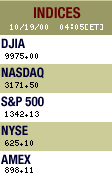
The Dow Jones industrial average fell 359.58 points, or 3.17
percent, to close at 10,997.93. The stock drop also helped push
money into bonds, with the benchmark U.S. 30-year Treasury bond
price rising over a point. Its yield, which moves in the
opposite direction, fell to 6.54 percent from 6.62 percent.
Clinton had wanted to name the Republican Greenspan for
another term. The only question was whether Greenspan himself
wanted to do it. He has held the job since then-President Ronald
Reagan appointed him in 1987. Greenspan's four-year term as chairman of the Federal Reserve Board expires next June.
Initial reaction from Capitol Hill was favorable.
"The president has made a wise and timely decision," said
Rep. Jim Leach, an Iowa Republican who chairs the House of
Representative's Committee on Banking and Financial Services.
"It underscores that the country has been well served by an
independent, nonpartisan Federal Reserve."
Wall Street Expected to Greet News With Enthusiasm
The news is expected to be greeted with enthusiasm on Wall Street, where Greenspan is seen as a steadying influence on the economy and one of the architects of the current economic expansion, which has produced the greatest bull market in US history.
The Fed raised rates three times over the past three months and
economists expect more to come. But with inflation remaining at low
levels, few analysts believe the Fed will be forced to raise
interest rates to such high levels in 2000 that it dumps the
economy into a recession.
The U.S. economy is enjoying its best performance in more than a
generation with low unemployment and low inflation. If the current
expansion lasts through February, something generally expected, it
will surpass the 1960s as the longest period of uninterrupted
economic growth in U.S. history.
Greenspan has won praise from many economists for his
willingness in recent years to allow the unemployment rate to fall
far below 6 percent, the level that used to be viewed as the danger
point where a dwindling pool of available workers would trigger
higher wage pressures and lead to rising inflation.
Instead, Greenspan threw his support behind the argument that
the huge sums being spent by American businesses for computers had
lifted America's productivity, the output per hour of work, to a
higher level that would allow the unemployment rate to fall without
triggering inflation.
Greenspan did voice worries about "irrational exuberance" in
the stock market back in December 1996, but he was willing to stand
back and let investors carry stock prices to ever-higher levels
since that time without trying to use interest rate policies to
deflate the investor boom.
Greenspan was a staunch backer of legislation that Congress
passed last year eliminating barriers that separated banks,
investment firms and insurance companies for more than 60 years.
He said he thought passage of the law would be a boon for
consumers, offering them greater choices. But Greenspan also warned
that financial regulators at the federal and state level will have
to cooperate more closely and be especially alert to deal with
"tensions" created by overlapping jurisdictions.
— The Associated Press and Reuters contributed to this report