Profit-taking mingled with concern about
higher interest rates shaved between three and four percent off
European stock indices on Tuesday, while bond yields retreated
after reaching two-year highs.
The euro held near six-week highs above $1.03, profiting
from weakness in U.S. asset prices and in optimism about
European economic growth prospects.
The sell-off on European bourses began when bond yields soared
on fears that interest rate rises were likely on both sides of
the Atlantic, and after the Dow's slide on Monday.
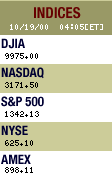
The slide continued apace after not only the Dow Industrials
average .DJI) began one percent down but the technology-laden
Nasdaq composite also shed more than two percent.
Previously high-flying technology and telecommunications
stocks were hardest hit in Europe, too.
``People didn't want to spoil the general trend last year,
but now they can start to see some risks,'' said Gerry Evans,
European strategist at Enskilda Securities in London.
Dutch software maker Baan saw its shares slump 30 percent
after it forecast a loss. German rival SAP was caught in the
downdraft and was off 4.13 percent.
Consumer products, financials and energy shares also
suffered heavy losses, the latter following a three-percent
overnight fall in crude oil prices.
``People are waking up to the fact that has been pointed out
to them for a few weeks now, that bond markets have been going
south quite quickly and are indicating that we really do expect
interest rate rises,'' said Evans at Enskilda.
``Equity markets have been ignoring that, but are now
starting to factor it in. That is the primary reason (for
today's weakness),'' he added.
Britain's FTSE 100 index stayed down 3.4 percent on Tuesday
afternoon, near its lows on the day.
Just Correcting End-Year Bubble?
But dealers said the market was just correcting some of the
inflated valuations that bubbled up during the volatile trading
seen over the dying sessions of last year.
Tech sector leader Nokia lost 8.71 percent while Finnish
telecom operator Sonera lost 12.3 percent. Energy shares were
led lower by a 4.9 percent fall in Shell Transport.
Shares in aero-engine maker Rolls-Royce Plc rose 4.44
percent after weekend press speculation about a possible merger
with U.S. rival Pratt & Whitney. Some investors also saw the
stock as undervalued, analysts said.
Pratt & Whitney parent United Technologies dismissed the
Rolls speculation as ``preposterous.''
In the insurance sector, shares in European's largest
insurer Allianz AG fell 8.3 percent despite Morgan Stanley Dean
Witter raising its rating on the German insurer to ``neutral''
from ``underperform.''
Equity Weakness Props Bond Prices
Euro zone government bond yields eased on bargain hunting
attracted by the previous high yield levels, and traders said
weakness in the equity markets was helping support bond prices.
Earlier euro zone bond yields hit two-year highs as possible
rate hikes and impending supply pressured the post-holiday
market.
The yield on the benchmark 10-year German Bund DE10YT-RR
smashed through 5.5 percent and peaked in European morning trade
at 5.559 percent before settling back.
The European Central Bank (ECB) Council meets on Wednesday
and holds a news conference afterwards, though no rate hike is
expected.
A Reuters poll of 36 European analysts, published on Monday,
found none expected the ECB to hike at its next meeting but that
22 expected a rate rise in the first quarter of 2000.
The euro held above $1.03 in early trade after an overnight
rally to six-week highs, and traders cited Monday's Wall Street
weakness and optimism over European growth for the euro surge.
The dollar held firm near 103 yen after rising on Bank of
Japan intervention during Tokyo trading hours.
Currency traders said all eyes were trained on U.S. stocks
and bonds for further direction.