Buyers beware: Your credit card might get
charged more than once because some merchants failed to update
their computer software for the Year 2000.
Visa and Mastercard said Friday they have checks in place to
catch duplicate charges, but they suggest that customers review
their credit card statements anyhow. A vast majority of
transactions are going through without problems, they added.
The problem is being caused by outdated IC Verify software from
CyberCash, which makes electronic transaction processing software.
The company offered free fixes last year, but some merchants didn't
get them.
As a result, merchants using IC Verify are charging customers
daily for the same purchase. For example, a customer's credit card
gets charged $400 Monday for a new color TV purchased that day. The
card is again charged $400 on Tuesday, another $400 on Wednesday,
and so on, until the software is fixed.
About 100,000 merchants use IC Verify. CyberCash spokeswoman
Sydney Rubin said "a significant number" made the proper upgrades
before the new year, though CyberCash received a flood of calls
late this week from merchants still needing updates.
The problem came to light late Wednesday when credit card
processors began noticing unusual charges.
Jack Gribben, a spokesman for President Clinton's Y2K advisory
council, said problems appear to affect mostly smaller retail
merchants, because major chains generally use their own software.
Smaller businesses were among the least prepared for Y2K. The
National Federation of Independent Business had estimated that up
to 1.5 million small employers did no Y2K preparation.
Linda Locke, a Mastercard spokeswoman, said duplicate
transactions "crop up from time to time, and in nearly all cases
banks are able to catch them ahead of time and reverse them."
If customers notice any problems, she said, they should contact
the bank that issued the credit card.
Visa spokeswoman Rosetta Jones said the number of duplicate
charges were in the thousands, out of 100 million transactions each
day.
The Y2K bug generally stems from a programming practice of using
only two digits to represent the year, so "00" might be misread
as 1900. In this case, though, the problem occurs because of the
way the software names its files.
The software keeps monthly records using the last digit of the
year, "0," followed by the month, "01." However, "001"
corresponds with another file that contains charges not yet posted.
So when the software tabulates payments at the end of each day, it
wrongly interprets items in the monthly paid file as outstanding
charges.
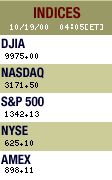
Shares of Cybercash dropped 18 3/4 cents to $8.75 in trading on the
Nasdaq Stock Market.