The merger of America Online and Time Warner means consumers should brace themselves for high-speed Internet access, because the next phase of the Web revolution has just begun, according to analysts.
Stuart Ramson/AP |
|
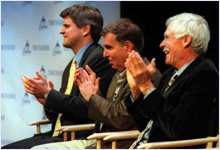
| Time Warner, the world's largest media and entertainment company, is being acquired by America Online for about $166 billion in stock in what would be the biggest corporate merger ever.
|
|
By acquiring Time Warner, the world's largest media and entertainment company, AOL has leveraged itself to deliver high-speed Internet access to millions of Americans.
Monday's record $160-billion stock deal gives the world's leading Internet provider a hook to Time Warner's 13 million cable-TV customers for Net access that is up to 100 times faster than delivery through traditional phone lines.
That means far faster download times and the ability to view rich information such as movies, music and 3-D graphics. However, some groups worry that the merger of two giants also will mean fewer choices for consumers.
Known for its mass-mailings of computer diskettes for dial-up
access, AOL is expected to aggressively promote its high-speed Net
service through Time Warner's media outlets. While AOL is by far
the largest provider of Internet access through traditional phone
lines with 22 million subscribers — including its CompuServe
service — its future growth is limited by uncertainty over how it
would deliver its entertainment, news and services over high-speed
Internet lines.
"We're still scratching the surface" of the Internet's
potential, AOL chairman Steve Case told a news conference.
Case will be chairman of the new company, which will be called
AOL Time Warner Inc., and Time Warner chairman Gerald Levin will be
its chief executive. America Online shareholders will own 55
percent of the company, and Time Warner shareholders the rest.
|
|
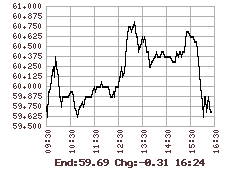
Today's trading on shares of AOL
|
|
|
Consumer and business appetite for alternate Internet access has
intensified because traditional phone lines often take
frustratingly long to connect to the Web, download information and
read graphics-heavy files.
But consumer advocates worry that AOL's control of Time Warner
could create a less competitive landscape that could actually
reduce choices to consumers seeking high-speed access.
Until its acquisition agreement, AOL was leading a charge to
convince regulators or courts to force cable TV operators — notably
AT&T; Corp. — to lease their high-speed connections to Internet
service providers, such as AOL.
The concern is that AOL will now abandon that fight and align
itself with AT&T;'s position. Indeed, as part of its own proposed
merger with the MediaOne cable company, AT&T; would get a 25 percent
stake in cable systems owned by Time Warner, linking it to the
AOL/Time Warner entity.
Case told reporters on Monday that the Time Warner deal will
allow the marketplace, not the government, to decide how Internet
service companies will get access to cable TV lines.
He did not elaborate. But several non-profit groups, citing the
AOL-Time Warner deal, urged the Federal Communications Commission
to consider requiring open access to the Internet.
"Steve Case is the Benedict Arnold of the digital age,"
charged Jeff Chester of the Center for Media Education, a
non-profit group. "He's campaigned all across the country for open
access. After he purchases access for AOL, he's no longer in favor
of public policy."
But AOL's new executives say their aim is to make the world a better
place by fighting social ills.
|
|
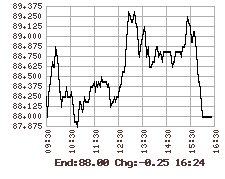
Today's trading on shares of Time Warner
|
|
|
``This is not just about big business. This is not just
about money,'' Levin said during a Tuesday morning television appearance. ``This is about making a better world for people because we now have the technology and the instruments to do that.''
One of the goals, Levin said, is to plug the so-called
digital divide, ``to try and make sure that ultimately those who
can't afford it can get it.''
Case, 41, said he expected the proposed merger, which is subject
to regulatory and shareholder approval, to have a quick impact
by making richer content more readily available among other
things.
``We're not talking about 10 or 15 years,'' he said. ``We
work on Internet time. This is a company that's going to move
fast. We want to see things every six months.''
AOL and Time Warner vowed to open what would be their vast
cable system to online rivals. In so doing, they moved to take a
debate over access to high-speed Internet pipelines out of
regulators' hands and into the marketplace.
The deal is subject to regulatory approvals and the approval of
AOL and Time Warner shareholders. The companies said the merger was
expected to be finalized by the end of the year.
—The Associated Press contributed to this story
—Reuters contributed to this story