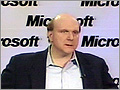
Microsoft co-founder Bill Gates announced Thursday that he was stepping down as chief executive officer at the software giant, and named long-time No. 2 Steve Ballmer to replace him in the job.

Anthony Bolante/Reuters |
|
| Bill Gates, left, is stepping down as Microsoft CEO and will be replaced by co-founder Steve Ballmer
|
|
Gates, who has served as chief executive of the company since he co-founded it 25 years ago, will remain chairman of the company and also take over the newly created position of
"chief software architect."
Gates said he wants to return "to what I love most — focusing
on technologies for the future." Over the past year and a half,
Gates has turned over much of the day-to-day operations of
Microsoft to Ballmer.
In some of his first statements as CEO, Ballmer wasted no time blasting any proposal to break his company into smaller pieces.
"It would be reckless and irresponsible for anyone to try and break up this company," he said, taking a defiant, hands-on-hip stance at a press conference at the company headquarters in Redmond, Wash. "It's the single greatest disservice anyone could do to consumers and this country. It's reckless beyond belief."
Gates did not pick up on Ballmer's tone, but did say that the development of product such as Windows 95 would have been impossible without the contributions of all the company's myriad divisions. He also said that all divisions of the company would need to work together to create the next generation of software that will take full advantage of the Internet.
"Today as I look at the office group, Windows, MSN, every one of those elements is necessary for us to create this new vision," Gates said.
Gates said he planned to dedicate all of his time to fashioning
and promoting the "next generation" of Microsoft's operating
system. The latest version, Windows 2000 for business computers, is
being released in the next few weeks.
Gates said he especially wants to develop software services that
will be available on the Internet.
Earlier in the day, reports began to surface that government prosecutors have agreed on a plan to break the company into smaller parts, often called "baby Bills," picking up on the nickname given to the companies spun off from AT&T;, which are known as baby bells.
— The Associated Press contributed to this report