Steve Ballmer has been crowned Microsoft's
new king, while Bill Gates may be aiming even higher.
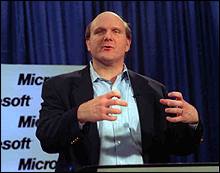
Barry Sweet/AP |
|
| Microsoft names new CEO: Steve Ballmer
|
|
Gates announced Thursday that he is giving up day-to-day
leadership of the company he co-founded in 1975 to return "to what
I love most — focusing on technologies for the future."
"I might be threatening to write code," Gates joked. "That's
something that I haven't been able to do in three or four years."
Ballmer was named chief executive of the software giant,
formalizing more than a year and a half of change at the software
company in both management and vision. He inherited the job from
Gates, who will remain Microsoft's chairman and become a full-time
"software architect."
Microsoft has made Gates the world's wealthiest person, with a
fortune estimated at more than $80 billion. His company has become
the dominant force in the software industry, with its Windows
operating systems on more than 90 percent of all personal
computers.
Gates said he planned to dedicate his time to fashioning and
promoting Microsoft's flagship operating system. The latest
version, Windows 2000 for business computers, is scheduled for
release on Feb. 17.
Barry Sweet/AP |
|
| Microsoft's Steve Ballmer, left, and Bill Gates announce change at the top
|
|
"Clearly, Gates is bored," said Michael Gartenberg, vice
president of the Gartner Group, a technology research firm. "He
loves innovation, and he loves to play with the technology. This
will let him do that."
Ballmer, 43, was appointed Microsoft president in July 1998
after being brought into the company eight years before by Gates.
The two met while attending Harvard University. Ballmer was Gates'
best man when he married Melinda French in 1994.
After Gates hired Ballmer, the two reportedly had some rocky
times. One anecdote says that in the spring of 1985, as Microsoft's
deadline to produce Windows slipped further and further behind,
Gates called Ballmer into his office and threatened to fire him if
Windows wasn't on the shelves by the end of the year (though few
people believe Gates, with a notoriously bad temper, was ever
serious about firing Ballmer).
Windows was ready by that November.
With Ballmer at the helm, Microsoft will likely become more
aggressive as it enters new technology markets with its new
Internet strategy. As Ballmer announced Thursday, the company will
market new software that can be accessed through any device — from
personal computers and handhelds to cell phones and toasters — via
the Internet.
Ballmer is seen as rather loud and blustery — he didn't bother
with a microphone at Thursday's news conference announcing his new
role — but his business credentials are impressive. As Microsoft's
longtime vice president of sales, Ballmer helped make Windows a
household name through the 1990s.
Like Gates, Ballmer has already staked out a position against
breaking up the company, which may be sought by the federal
government and 19 states suing Microsoft over alleged antitrust
violations.
Ballmer said a breakup would be "absolutely reckless and
irresponsible" and "the single greatest disservice that anybody
could do to consumers in this country."
David Wu, a financial analyst at ABN Amro in San Francisco, said
few differences exist between Ballmer and Gates.
"Other than the fact that Steve Ballmer is less rich than Bill
Gates, those two are Siamese twins," Wu said.