Alan Greenspan, nominated for a fourth term as chairman of the Federal Reserve, pledged to Congress Wednesday that the
central bank under his leadership would continue to pursue policies
that will promote "low and stable inflation."
But Greenspan also told the Senate Banking Committee that the
economy is reaping the fruits of a "marked pickup in technological
innovation" that has boosted productivity and translated into
rising living standards for millions of Americans.
"Our challenge in monetary policy is to foster, as best we can,
the financial conditions that will allow this economic expansion
and technological revolution to continue as long, and as
vigorously, as possible," Greenspan said in his prepared testimony
for the committee.
In his brief opening remarks, Greenspan provided no hints about
the Fed's next moves on interest rates. But he stressed that the
central bank clearly understands its most important job in
supporting the U.S. economy's long expansion, which next month will
set an all-time record for length, is to fight inflation.
"Experience has demonstrated that an essential ingredient in
this prosperity, and an ingredient for which the central bank has
ultimate responsibility over the long run, is low and stable
inflation," Greenspan said. "Maintaining price stability ...
reduces the likelihood that imbalances could develop that would
ultimately undermine economic expansion."
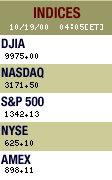
Stock prices took a huge tumble Monday, partly on fears about
what Greenspan would say in his testimony before Congress this
week.
Most economists believe the central bank, which last year
boosted interest rates three times in an effort to keep the red-hot
economy from overheating and triggering rising prices, will boost
rates a fourth time at its meeting next week. So far, there are few
signs that the Fed's earlier interest rates moves have had the
desired effect of slowing economic activity.
Greenspan, 73, was nominated earlier this month by President
Clinton for a fourth term as chairman of the Fed. He has headed the
central bank since 1987 when Ronald Reagan selected him to succeed
former Paul Volcker. He was renominated for a second term by George
Bush in 1992 and by Clinton in 1996.
The nomination is expected to meet little resistance. The Senate
Banking Committee chairman, Sen. Phil Gramm, R-Texas, said before
the hearing that he expected his committee would vote on Greenspan
on Tuesday. He said he hoped to bring it before the full Senate
quickly after that vote.
Senate Majority Leader Trent Lott, R-Miss., predicted Tuesday
that approval for Greenspan "will go quickly" and he praised what
he called "a smart move by the president" to select Greenspan
rather than someone else to head the Fed.
Clinton had been expected for months to offer the Fed
chairmanship to Greenspan again, given that the
Republican-controlled Senate was unlikely to approve any other
appointment by a Democratic president in his last year in office.