They've become popular figures in shopping
malls and inspired the name of a rock band, but the crash test
dummies made famous in seat belt ads are taking a back seat to a
new set of more shocking TV spots.
AP/Wide World |
|
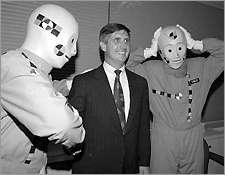
| Crash dummies Larry and Vince
|
|
The National Highway Traffic Safety Administration has decided
that ads featuring the dummies affectionately known as Vince and
Larry will be replaced next month with a pair of graphic ads aimed
at breaking through the recent plateau in seat belt usage.
Instead of seeing lifelike dummies dust themselves off after a
crash, viewers will see human actors engaged in common moments that
are cut short by an automobile accident.
In one spot, titled "Ice Cream," a husband out buying ice
cream to satisfy his pregnant wife's midnight craving has his car
hit head-on as he pulls out of the driveway. In a second ad, titled
"Cruising," teen-agers in two cars cruising down a street giggle
until one of the cars is smashed by a speeding van.
After each scene, the caption on the screen asks, "Didn't see
that coming? No one ever does. Buckle up."
"The idea behind the campaign was to really take a bold step
and change our direction to reach those users who are taking short
trips but not wearing their seat belts," said Ken Ulmer, spokesman
for the Advertising Council. It is marketing the spots, made by the
Chicago ad agency Leo Burnett, for the traffic safety
administration.
"We are not reaching part-time users, people who take trips to
the store or out to pick up their kids. The statistics show they
are at risk, too," Ulmer said.
Vince and Larry have been successful seat belt salesmen for 15
years. With their gray jumpsuits and revolving heads, they have an
appeal similar to that of the hapless but durable Star Wars tin
man, C-3PO. The pair is mobbed at mall appearances and have had
their name reach into the music industry thanks to the band,
Crash Test Dummies.
Beyond their public appeal, Vince and Larry have gotten results.
In 1985, about 21 percent of the driving population wore seat
belts; in 1996, the figure was up to 68 percent.
That, however, is about where it has stayed.
President Clinton has announced a goal of getting seat belt
usage up to 85 percent by the end of the year, but traffic safety
experts concede there are some high-risk drivers who will never
wear seat belts. The new campaign is focusing on the casual wearer
— someone who is not against buckling up, but who does not do so on
every trip.
Dr. Ricardo Martinez, head of the National Highway Traffic
Safety Administrator and a former emergency room physician, pushed
for the new advertising approach after watching a series of
gruesome traffic commercials aired in Australia.
The challenge for the U.S. ad makers was to walk the fine line
between spurring people to action and repulsing them into
disbelief.
"What will inhibit people is if they say, `Yes, but that's not
really me,"' said Emily Soell, a member of the Advertising
Council's advertising review committee.
"What was most important was the line afterwards, because that
implies that the people survived and gets people to say, `Yes, with
an accident, you never see it coming, so I better buckle up."'
Ulmer, the Advertising Council spokesman, said the crash test
dummies are in "semi-retirement." He expects them to be used
again in children's programming.
Soell, meanwhile, said Vince and Larry are victims of their own
success.
"After a while, even the best advertising begins to blur itself
because people have seen it so much that they no longer listen,"
she said.
"People found it so entertaining they end up paying attention
more to the entertainment value: `Oh, I wonder what the seat belt
dummy is going to do now."'
The Advertising Council, a nonprofit group that works to gain
free air time and print space for public service announcements,
will begin showing the commercials in all major advertising markets
by mid-February.