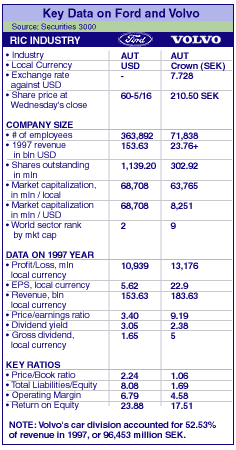
Ford Motor Co. is buying the passenger
car division of Sweden's Volvo AB for $6.45 billion, adding another
premium brand name to the portfolio of the world's No. 2 automaker.
Carlos Osorio/AP |
|
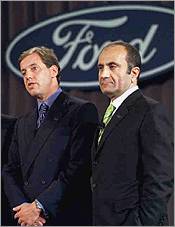
| Ford Chairman William Clay Ford Jr. and Jac Nasser, Ford's president and chief executive officer
|
|
Under the agreement announced today, Ford is expected to assume
ownership of Volvo Cars' worldwide sites, including three assembly
plants and two powertrain plants in Europe and the
passenger-vehicle product development center in Gothenburg, Sweden.
Ford also gets the right to use the Volvo brand for passenger
cars, minivans, sport utility vehicles and light trucks. Volvo
retains its corporate brand for commercial vehicles and
non-automotive products.
The deal is subject to approval by regulators and stockholders.
Ford is no stranger to Sweden, where the U.S. automaker has been
operating since 1924 and now sells passenger and commercial
vehicles through an 87-dealer network.
"We are not just in Sweden, we are part of Sweden," Jac
Nasser, Ford's president and chief executive officer, said this
morning. "And through our new relationship with Volvo, we plan to
be part of the fabric of the country for many years to come."
Volvo said the sale would allow the company to concentrate on
its other operations, including commercial vehicles and interests
such as construction equipment, marine engines and aerospace
equipment.
It also said being part of a "very large automotive company"
would allow it to invest more in development and distribution.
"Now, Volvo can concentrate its resources towards becoming a
world leading producer of commercial products," said Volvo
president Leif Johansson, according to the Swedish news agency TT.
The merger is complementary for both companies, said analyst
Gregory Kagay, of McDonald & Co., in Birmingham, Mich.
"This is sort of like a whale swallowing a guppy," Kagay said.
"The implications for the industry are not overwhelming."
But some analysts had questions about the deal. Nick Colas, with
Credit Suisse First Boston in New York, said, "it's an interesting
acquisition but an over the top price. ... It exceeds the financial
value of Volvo," by $3 billion, by his company's estimate.
Volvo has been one of several auto companies considering mergers
or acquisitions since last year's merger of Chrysler Corp. and
Daimler-Benz AG. Italy's Fiat SpA and Germany's Volkswagen AG had
reportedly expressed interest in Volvo, but recent speculation had
focused on Fiat and Ford.
Business Week magazine reported Wednesday that Ford's offer won
out over a $7 billion bid by Fiat SpA, which also wanted to
purchase Volvo's commercial truck business. Ford has nearly $24
billion in cash, Fiat just a $1.5 billion reserve.
Fiat said today it only wanted to buy the entire company.
"The acquisition of just the car sector wasn't in our strategic
interests and therefore was never part of our negotiations," the
company said in a release.
Acquiring Volvo will allow Ford to expand its 10 percent share
of the European market by offering a broader line of near-luxury
sedans and station wagons. Volvo would also help Ford in its effort
to market itself as a leader in automotive safety.
"Volvo has a world-class reputation for safety, quality,
durability and environmental responsibility — all of which are
attributes that are increasingly important to our customers,"
Nasser said.
Ford already owns Britain's Jaguar Cars Ltd., whose cars are
priced well above Volvo's. Ford's European cars, meanwhile, are
priced below Volvo's.
"The interesting thing is there's so little overlap, even with
Jaguar," said analyst Joe Phillippi of Lehman Brothers. "Volvo
prices end way before Jaguar prices start, so that's not really an
issue. In Europe, it helps them enormously."
Ford earned $22 billion last year, more than triple the $6.9
billion it earned in 1997.
Volvo, one of the world's smaller automakers, produces fewer
than 500,000 vehicles annually. Last year it sold 400,000 cars,
100,200 of them in the United States. Sweden was its second-largest
market, with 53,600 cars sold.
This isn't the first time Volvo has been involved in merger
discussions.
Stockholders blocked a proposed merger with Renault SA of France
in 1993. Opponents, mostly small shareholders in Sweden and
mid-level managers, were worried about control of Volvo and jobs
moving outside Sweden, where manufacturing costs are high.
That may be less of a concern with Ford as an owner, based on
the way the automaker has handled its acquisition of Jaguar,
keeping it as a largely separate entity based in England.
"Ford is the best partner that has been mentioned in the
discussions," said Christer Karlsson, a Stockholm School of
Economics professor.
"It would be a disaster if they Americanized Volvo, but I'm
sure that they don't want to damage the trademark, but rather
strengthen it," he said. "Ford has let Jaguar stay an English
car."