NEW YORK —The long party for stocks could be over, at least to those who believe in the so-called "January indicator."
For the first time in eight years, all of the broad stock market indexes fell in January, an ominous sign for those market watchers who use the indicator to predict the future.
Market lore has it that when the major indexes rise in January,
stocks will gain over the full year, and vice versa.
Indeed, since 1950 the January indicator has only been wrong
three times, according to Yale Hirsch, author of the "Stock
Trader's Almanac."
But the stock market is rife with such indicators, and most
professional stock-pickers take them with a grain of salt.
"It's too early and there's too much mixed data out there to
throw in the towel for the year," said Brian Belski, chief
investment strategist at George K. Baum, a Kansas City, Mo.-based
brokerage firm.
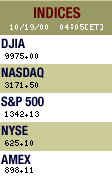
The Dow Jones industrial average, the most closely watched
index, ended January at 10,940.53, down almost 5 percent from its
close on Dec. 31, 1999. The average of 30 blue-chip stocks also was
off almost 7 percent from the record 11,722.98 reached Jan. 14.
It also was the first January retreat since 1992 for the
Standard & Poor's 500-stock list.
The broad S&P; 500 index, favored by most Wall Street
professionals, fell about 5 percent in the first month of the year,
and the technology-heavy Nasdaq composite index slipped slightly
more than 3 percent.
Fed Hike Could Hurt Stocks
A number of factors contributed to those declines, not the least
of which was investors simply taking profits after record-setting
stock market gains during the fourth quarter of 1999.
In addition, the roaring U.S. economy has put Federal Reserve
Board policy-makers on guard for signs of creeping inflation, a
threat that has led to three interest rate hikes last year.
A fourth rate hike is widely expected on Wednesday, and
investors traded cautiously throughout January bearing that in
mind.
Higher interest rates hurt stocks because they make it more
costly for companies to borrow money to expand their businesses,
cutting into earnings.
Notwithstanding the track record of the January indicator, few
worry that one down month will derail the longest running bull
market in history.
Belski said the wild mood swings exhibited by the stock market
in recent months are typical of a full-blown bull market. Investors
are edgy, he said, and prone to making quick decisions based on
emotions. So the January selloff was hardly surprising, he added.
Various Indicators Don't Always Predict Future
When taken in their proper context, some indicators can be
helpful, analysts believe. But none should be considered some sort
of crystal ball that can be used to shine a light into the future.
The Presidential election indicator, for example, is based on a
historical precedent that presidents tend to be more conservative
in their last two years of office so as not to disturb the economy.
Consequently, the status quo remains intact and stock markets tend
to go up.
During the 20th Century, the Dow Jones average fell just seven
times during 25 Presidential election years, according to Hirsch's
"Stock Traders Alamanac."
Hirsch said these types of gauges can be thrown off by
extraordinary circumstances. "There's no such thing as a perfect
indicator," he said.
The current interest rate environment, for example, held stocks
down in January but probably won't affect the rest of the year, he
said.
But What About the Booming Economy?
Stocks will likely climb higher in 2000 regardless of the
January indicator because the U.S. economy is booming, company
earnings are strong, overseas markets are healthy and the Internet
is changing how the world does business, Hirsch said.
One indicator that has no one worried is the so-called Super
Bowl indicator, which suggests — somewhat arcanely — that when an
original member of the old American Football League wins the Super
Bowl in January the stock markets will tumble that year.
The Denver Broncos were original members of the AFL, however,
and the team won consecutive Super Bowls in 1998 and 1999 in the
midst of the current bull market.
Conversely, when the Super Bowl is won by an original member of
the National Football League, which merged with the upstart AFL in
the early 1960s, the markets are supposed to go up. But that
indicator clashes this year with the pall cast by the January
indicator since the St. Louis Rams, winner of Sunday's Super Bowl,
were an original NFL member.
Robert Robbins, chief investment strategist at Robinson-Humprey,
an Atlanta-based brokerage firm, dismissed football indicators
outright.
"There's no reason to believe that football has anything to do
with the stock markets," he said. "That's just something that's
fun to talk about."
— The Associated Press contributed to this report