Americans' personal income surged 0.5 percent in December, the best gain in 10 months, and they spent every bit
of it and more.
The increase in personal income, the most since February,
followed 0.4 percent gains in October and November, the Commerce
Department said Monday.
Personal spending surged 0.8 percent, the biggest increase in
seven months, bolstered by last-minute holiday shopping and a
continuing rebound in auto sales after summer strikes at General
Motors. That followed a modest 0.2 percent increase in November.
Separately, the department said construction spending surged 1.7
percent in December, the largest gain in six months, helped by
unseasonably mild weather for much of the month.
Also, an index compiled by the National Association of
Purchasing Management showed manufacturing declined for the eighth
consecutive month in January, but at a slower rate than during the
previous seven months.
Norbert J. Ore, chairman of the organization's survey committee,
found "signs of encouragement." These included marked increases
in both production and new orders.
Because Americans spent more than they earned in December, their
personal savings rate — savings as a percentage of after-tax income
— went negative for the second time this year. It was zero in
September, minus 0.1 percent in October, positive 0.1 percent in
November and minus 0.1 percent again in December.
For the year, Americans saved just 0.5 percent of their income,
the least since 1933, compared with 2.1 percent in 1997 and 2.9
percent in 1996. But, the figure is not as grim as it appears.
In 1933, the lack of savings reflected the huge drop in income
Americans experienced during the depths of the Great Depression. In
1998, the low savings rate came because prosperous Americans spent
a portion of their stock-market gains and tapped their home equity
during a wave of refinancing spurred by the lowest mortgage rates
since the 1960s.
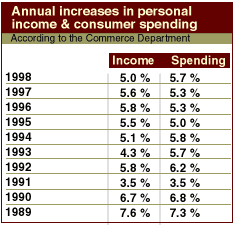
Income in 1998 rose a healthy 5 percent, the fourth consecutive
year at or above that level, but still the smallest rise since
1993. That included a 6.7 percent increase in wages and salaries —
the most-watched component of income — and a 23.6 percent plunge in
farm owners' income, reflecting the worldwide economic slump's
impact on commodity prices.
Spending jumped 5.7 percent, the largest gain since 1994. It was
propelled by a 7.5 percent increase for big-ticket durable goods,
as low interest rates fueled car sales and record home sales
encouraged strong sales of furniture and appliances.
In December, wages and salaries rose 0.5 percent. Service
industries showed a brisk 0.7 percent gain and manufacturing, a
more subdued 0.2 percent rise.
Spending during the month was led by a 4.2 percent surge for
durable goods, items expected to last three or more years. It was
the largest gain in 5 1/2 years. Spending on services rose 0.4 percent
and on nondurable goods, 0.1 percent.
Construction spending, for the year, rose 6.3 percent to $657
billion, following a 5.9 percent rise in 1997. The categories with
the biggest gains included single-family homes, 13.9 percent;
apartments, 8 percent; offices, 16.4 percent, and hotels and
motels, 12.6 percent.
Those increases offset drops of 0.6 percent in government
construction, 1.5 percent in shopping centers and other commercial
buildings, and 3.7 percent in industrial construction.
In December alone, housing construction rose 1.6 percent;
commercial, 1.4 percent, and government, 3.7 percent. There were
substantial increases for construction of single-family homes,
offices, and highways and streets, but drops for hotels and motels
and industrial buildings.