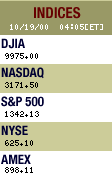
Blue-chip stocks gave back moderate gains in the final minutes of trading to end lower, but the Nasdaq composite
inched higher to close at a record level for the third consecutive
session.
The Dow Jones Industrial Average ended 13.13 lower at 9,345.70,
breaking two days of gains. The blue-chip index opened higher after
European stocks scored strong overnight gains and Washington
released an economic report that indicates new strength in the
manufacturing sector.
The Dow waffled at mid-morning but regained its strength, moving
as high as 9430.66, up nearly 72 points from Friday's close, only
to retreat a second time in the final 20 minutes.
And although the Nasdaq composite managed to push to a record
high again, the Standard & Poor's 500 composite ended lower.
The Dow industrials were led higher by AT&T;, after the
telecommunications giant announced a deal to provide telephone
service over Time Warner's existing cable television systems. Time
Warner shares rose as well.
The Dow components were also supported by Hewlett-Packard, whose
shares rose sharply after that company introduced a new line of
printers.
Stocks opened higher after a strong showing in overnight trading
in Europe, and after Washington released data showing that
consumers earned and spent more money last December. The Commerce
Department reported that Americans' personal income climbed 0.5
percent that month, while personal spending surged 0.8 percent.
At 10 a.m., the market got another boost as the National
Association of Purchasing Management reported that its index of
manufacturing activity rose to 49.5 percent in January from 45.3
percent in December.
Although a reading under 50 percent is a sign of contraction in
the industrial sector, the increase was bigger than economists had
expected, and it sent manufacturing shares higher. Among Dow
components, for example, General Motors rose more than 3 points.
The purchasing data represented "a very strong rebound" in
manufacturing, said Anthony Karydakis, senior financial economist
at First Chicago Capital Markets, Inc. Combined with last week's
report on strong gains in durable-goods orders, and a strong report
from the Philadelphia area on manufacturing activity, "shows a
manufacturing sector making a comeback," Karydakis said.
But Tuesday's meeting of Federal Reserve policy makers dampened
Wall Street's enthusiasm, said Barry Berman, head stock trader for
Robert W. Baird & Co. in Milwaukee.
"The Fed is kind of stuck," Berman said, between an impulse to
cool the stock market down because its high-flying advances could
prove inflationary, and the realization that any action that would
send the market lower could slow consumption and have grave
consequences for the economy.
The Fed is "taking the stock market into consideration more
than they ever have as a factor in everybody's economic
well-being," Berman said. "It's gotten to be a bigger part of
everybody's wealth, and as such, if people were to suddenly lose a
portion of that, it would affect their spending habits, which would
affect the market."
Meanwhile, some merger news helped individual names.
Rohm & Haas agreed to buy salt processor Morton International in
a transaction worth $4.9 billion. Morton's shares shot higher, and
Rohm & Haas's rose as well.