A key gauge of U.S. economic activity rose a
sturdy 0.4 percent in December, suggesting that the nation's record
expansion will continue well into Year 2000.
The Conference Board said today its Index of Leading Economic
Indicators increased to 108.7, yet another record level, in
December from 108.3 the month before. The rise was in line with
analysts' expectations.
In Washington, the Commerce Department reported today that the
sales of new homes rose 4.5 percent in December, helping to boost
the total for the year to an all-time high.
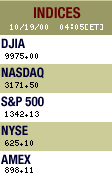
The two strong economic readings contributed to stock market
jitters as it waited for Federal Reserve policy-makers, meeting in
Washington for a second day, to announce moves aimed at cooling the
economy and hedging against inflation. An interest rate increase
was expected.
The Dow Jones industrial average was up slightly by late
morning, adding to two days of strong gains on expectations that
even a fourth rate hike since June would not stop a broad rise in
corporate earnings.
The Conference Board, a business-funded research group, said
that nine of the 10 components that make up its leading index rose
in December. The 10th, which measures the average workweek in
manufacturing, was unchanged, it said.
"The leading indicators point to a continuation of the
expansion during 2000," the report said.
The index is watched closely because it is a barometer for
economic activity in the next three to six months.
The nation's current economic expansion, now at 107 months, is
widely expected to continue. Many analysts estimate that the
nation's gross domestic product is growing at an annual rate of
about 3 percent to 3.5 percent in the current quarter following the
blistering 5.8 percent growth rate in last year's fourth quarter.
The GDP is a measure of the output of all the nation's goods and
services.
"This report is more evidence that the economy has a great deal
of momentum," said Bryan Jordan, an economic analyst at Banc One
Investment Advisors in Columbus, Ohio. "It's not about to slow on
its own any time soon."
Jordan said he expects the Fed to raise rates as much as a full
percentage point this year but still predicts that the economy will
grow about 3.7 percent in 2000, down just slightly from last year's
4 percent growth.
The reading for December is the highest since 1959, the first
year the index was calculated in a way that is comparable with
current figures. The record mark was first passed in November.
The report from the New York-based group said that its index of
coincident indicators, measuring current activity, increased 0.2
percent in December to 126.8 from a revised 126.5 in November. The
index of lagging indicators, which tracks past activity, went up
0.5 percent to 109.4 in December from 108.9 percent in November.
The separate home sales report said that Americans purchased new
single-family homes at a seasonally adjusted annual rate of 900,000
in December, aided by better-than-normal weather. December's 4.5
percent increase, bigger than the 4 percent rise many analysts were
forecasting, followed a 6.3 percent decline in November.
For all of 1999, new-home sales rose 2 percent to a record
904,000, surpassing the previous record of 886,000 in 1998.
Existing-home sales tracked by the National Association of
Realtors also set a record in 1999 of 5.2 million despite the
upswing in mortgage rates.