There were snide comments and many, many jokes.
And when Maryland state trooper Kevin Knussman won his four-year
legal fight this week against the bosses who denied him parental
leave, only a couple of colleagues called to congratulate him.
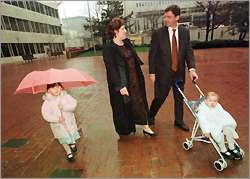
Gail Burton/AP |
|
| State trooper Kevin Knussman won a four-year legal fight this week against the state police who denied him parental leave
|
|
Knussman's victory highlights the rights of working fathers to
take time off with their babies. But his isolation shows how
balancing a job and a family remains a silent struggle for many
men.
"Much of the progress (for working fathers) is still going on
underground," says James Levine, a leading researcher on
fatherhood and co-author of the book Working Fathers.
Fearing — often with reason — that they'll be labeled slackers,
fathers cobble together sick days and vacation time to create leave
time after a baby is born. When they want to go to a school play,
they dash for the door, under cover of attending a "late
meeting."
Ben, a New York city money manager and father of a 3-month-old,
carefully left his computer on and his desk lamp lit not too long
ago when he took his wife to the hospital for a sonogram. "It made
it look like I was still there," said Ben, who refused to be
further identified, fearing for his career. "Plus, it made me feel
better."
Progress has been made, albeit slowly, in accepting men's
growing desire to be involved parents.
Asked 15 years ago how much unpaid parental leave time was
reasonable for men to take, 63 percent of business leaders at large
companies said, "none." Even 40 percent of executives at
companies with a parental leave policy at the time nixed the idea
of actually using it, according to Catalyst, a non-profit group
that studies women in business.
Today, half a million men take some sort of parental leave each
year to care for a new child, under the auspices of the 1993
federal Family and Medical Leave Act. That compares with 1.4
million women.
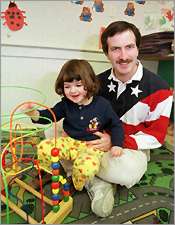
Mike Derer/AP |
|
| Howard Nathanson, a computer analyst with AT&T; says he never felt any opposition from his employer when he took nine months of parental leave |
|
A total of 20 million people have taken leave under the federal
law, which says all employers with 50 or more workers must allow up
to 12 unpaid weeks off to care for a new baby or seriously ill
family member.
Knussman, a helicopter paramedic, sued the state police after he
was denied 12 weeks leave following the birth of his daughter in
1994. He was given 10 days off, but sought more time because his
wife experienced childbirth complications.
On Tuesday, a jury awarded him $375,000 in damages for mental
anguish, in the first sex discrimination case under the Family
Leave act. Attorneys for the state police said they may appeal.
"There's still a presumption that women are going to be the
primary caretaker," said Sara Mandelbaum, an American Civil
Liberties Union lawyer who represented Knussman. "Those attitudes
are hard to change, especially in a male-dominated organization
like the state police."
Some companies do encourage fathers to take parental leaves —
and more men are taking them. AT&T; offers new parents up to a year,
unpaid, with a guaranteed job upon return. About one man takes
advantage of the program for every 18 women. That's up from a
1-to-400 ratio a decade ago.
Howard Nathanson, an AT&T; computer analyst, says his co-workers
and bosses fully supported his decision to take nine months
parental leave in 1996. "There was never any grief about this,"
he said.
But for other men, obstacles, both perceived and real, prevent
their making use of work-family programs.
Not only do men fear career trouble or teasing if they openly
make family a priority, but they feel, sometimes rightly so, that
work-family progams are mainly pitched to women.
Money also plays a role. A few companies, including Merrill
Lynch and the software maker Lotus Development Corp., offer paid
leaves for men. But most don't, and since men are major
breadwinners, it's hard for them to take unpaid time off.
Nathanson and his wife, for example, both felt strongly that one
parent should be home with their daughter for a year. Since she
earns two-thirds of the household income, he stayed home.
"Financially, I wasn't burned by the fact that if I took off,
there goes the family income," he said.
For now, many men choose to do what they can, when they can.
Clark Adams, chief executive officer of Needham, Mass.-based
Mulberry Child Care Centers, says fathers pick up or drop off 25
percent of children at the company's 55 centers daily, and more are
serving on parent advisory committees.
Still, Knussman is glad he took a stand. After he filed his
suit, the state police gave him a full 12 weeks off following the
birth of his second child.
"Biting the hand that feeds you is never easy," he said by
telephone as his daughters giggled in the background. But taking
three months off was "just a great, great time. I will never, ever
regret that."