U.S. stocks slumped in late
afternoon trading on Friday as a slide in the shares of the
world's biggest software company Microsoft dragged heavily on
the major stock market indexes.
Osamu Honda/AP |
|
| Overall, analysts say Friday's losses on Wall Street are part of a normal correction for stocks
|
|
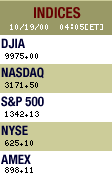
The Dow Jones industrial average fell 218.42 points, or 2.05 percent at 10,425.21 — its lowest level since late October. The Dow hit an all-time high of 11,722.98 on Jan. 14. The Nasdaq Composite Index was off about 90 points to 4,395.52, a 2 percent decline, while the Standard & Poor's 500 Index closed at 36.36, or 2.57 percent at 1,380.
A drop of more than 10 percent is considered to be a "correction," or a sharp downturn in a rising market. A correction often occurs in a bull market, and does not necessarily
mean an end to the overall upward trend.
Microsoft, a Dow component and one of the largest stocks in both the Nasdaq Composite Index and the Standard & Poor's 500 Index, fell sharply after a study questioned whether its new Windows 2000 system could interact smoothly with other software. The stock was down 5-9/16 to 100-7/16 in heavy trading.
Also raising investor concerns were comments Thursday night from Michael Dell, chief executive of Dell Computer Corp., that chilled some of the expectations for the release of Windows 2000, Microsoft's latest personal-computer operating system, due to be formally introduced next week.
Technology consulting firm Gartner Group said in the report one in four corporations moving to Windows 2000 would run into problems with the new system being compatible with existing software. The software upgrade is specifically designed for business customers.
Even so, analysts said the report raised no fresh issues.
"In reacting to the Gartner Group study, investors are reacting to a rehash of a story that is a year old," said Credit Suisse First Boston analyst Michael Kwatinetz. "Are there people out there who don't know what's going on? Of course there are. This kind of news will affect the stock, but in a more temporary way."
Gartner's Michael Gartenberg, author of the report, said the study was "not meant to be a forum to release new and major findings. This is stuff we've been saying for quite some time." Also, analysts said they were more concerned about statements made by Michael Dell during the conference call after his company, the No. 1 direct seller of PCs, released its fourth-quarter earnings report late Thursday.
Dell said the Linux operating system, considered an alternative to Microsoft Windows, was gaining momentum, and that there was no rush of corporate customers upgrading hardware systems for Windows 2000.
"We don't see a massive immediate acceleration due to Windows 2000," said Dell.
Kwatinetz said such an immediate rush to Windows 2000 was not to be expected. He focused on Dell's positive remarks about the alternative Linux operating system, saying these comments could be more significant.
"He (Dell) gives the feeling that there are some other new operating systems that are going to pose a challenge to Microsoft," he said.
Overall, analysts said Friday's losses on Wall Street were part of a normal correction
for stocks. But the market for technology stocks and that of blue chips has been markedly different of late, with the technology-led Nasdaq scoring records while the Dow has slid in three of the past four sessions.
"The market has come an awfully long way and it really needs a pause," said James Oberweis Sr., president and portfolio manager of Oberweis Asset Management in North Aurora, Ill.
"I believe we need a period of ups and downs where we don't make much progress to give earnings a chance to start to catch up with valuations," he said.
In economic news, retail sales rose 0.3 percent to a seasonally adjusted $262.21 billion — a smaller than expected gain by Wall Street economists. Excluding auto sales, sales
actually fell 0.3 percent while a 0.5 percent boost had been expected.
But countering signs of a let-up in consumption was word that a big shopping spree in December actually resulted in a 1.7 percent jump in retail sales while the Commerce Department had earlier reported only a 1.2 percent boost.
Consumer spending fuels two-thirds of U.S. economic activity, which means the retail sales numbers are considered by the U.S. Federal Reserve when it decides whether to raise
interest rates to ward off inflation.
Big computer makers were down with Dow member International Business Machines Corp. falling 4 at 115-1/8.
"You are seeing some very normal profit taking in the high techs," said Alfred Goldman, technical analyst at A.G. Edwards and Sons in St. Louis. "The only question is whether it is going to last a couple of days or a couple of weeks. Retail sales were very positive for the market. That is why bonds are up."
— The Associated Press and Reuters contributed to this report.