Wall Street will be waiting this week
to hear what kind of Valentine Alan Greenspan, the head of the
U.S. central bank, sends financial markets when he testifies to
Congress Wednesday.
The market is also expecting data on wholesale and retail
prices, which will help economists gauge the temperature of
inflation and the threat of future interest rate hikes.
Greenspan will give his semi-annual Humphrey-Hawkins
testimony on monetary policy before the Senate Banking
Committee, and investors are looking for clues as to just how
hawkish the head of the Federal Reserve is feeling after several
reports of strong economic data.
"The market's expecting them to raise rates because the
economy has been advancing at a fairly rapid rate compared to
what (the Fed) would like to see," said Joseph Stocke, chief
investment officer at StoneRidge Investment Partners in Malvern,
Pa.
He said because Greenspan tends to make monetary policy
changes slowly and gradually, the chances of the Fed going
beyond the forecast 25-basis-point hike to an increase of 50
basis points was real were slim unless this week's economic data
had inflationary signals.
The government is due to report the producer price index
(PPI) for January Thursday and the consumer price index (CPI)
Friday.
If evidence and concerns mount that inflation may turn
higher, economists said it may prompt central banks to extend
the rate hike cycles started in 1999.
James Volk, co-director of institutional trading at D.A.
Davidson and Co. in Portland, Ore., said that although markets
tend to lurch quickly after surprising economic reports, for the
most part the stock market has been able to absorb strong
reports. The Nasdaq is near record levels, although a sell-off
Friday brought the high-tech index down slightly and knocked the
Dow, which has been well off its highs, into what is generally
agreed to be a correction.
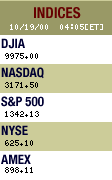
The Dow is now down 11.1 percent from its January 14 closing
high of 11,722.98. Ned Riley, stock market strategist for State
Street Global Advisors of Boston, said that big losses in areas
like automakers, paper companies, and home builders are sending
a signal that many investors are betting conditions will worsen
in the future.
Computing giant Hewlett-Packard Co. is among the big
earnings reports due next week. First Call/Thomson Financial
pegs analysts' estimates for the fiscal first quarter at $0.77 a
share compared to $0.85 in the year-ago quarter. Despite
warnings from competitors like Dell Computer Corp., H-P
officials have said they expect revenues and profits to grow
12-15 percent in 2000.
Analysts will also be keenly watching the rising price of
oil as well as any news of trouble at any large hedge funds.
Rumors of some funds getting squeezed by the wild moves in the
bond market set nerves on edge last week, analysts said, though
much of the fear was quelled after a U.S. debt auction showed no
signs of torrid demand.