Federal Reserve Chairman Alan Greenspan called
the economy's record-breaking performance the best in a half-century, but he warned Thursday that inflation remains a threat to the economic good times that many Americans are enjoying.
AP |
|
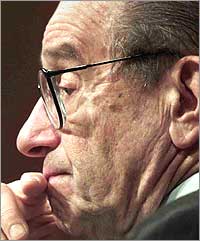
| Federal Reserve Chairman Alan Greenspan warned that interest rates may have to go up to fend off inflation.
|
|
In his twice-a-year report on the economy before Congress, Greenspan Thursday
declared the current good times "unprecedented in my half-century
of observing the American economy." But he cautioned that
inflation dangers still exist and put financial markets on notice
to expect further interest rate increases.
Greenspan said conditions are remarkable with
the 9-year-long expansion, a record, turning in exceptionally rapid
growth that has driven unemployment to a 30-year low of 4 percent.
Ninety minutes before Greenspan spoke, the Labor Department
reported that wholesale prices were unchanged in January and that
when the volatile energy and food sectors are excluded, the
Producer Price Index fell by 0.2 percent.
Wall Street viewed Greenspan's remarks to the House Banking
Committee as confirmation that the Fed will continue to rachet up
interest rates this year until the economy slows to a more
sustainable pace.
Even though inflation has remained low outside of a burst in
energy prices, Greenspan said, this favorable condition cannot last
unless the growth rate slows to less than the 4 percent-plus gains
of the past three years.
Greenspan tied his worries to the tight labor markets and fears
that workers will begin to demand higher wages that could set off
an inflationary spiral. Since last June, the central bank has been
trying to slow the economy, raising a key interest rate it controls
by a full percentage point.
 |
 |
 |
| |
'Mr. Greenspan is telling us to expect higher interest rates' — Sung Won Sohn
|
|
 |
 |
 |
|
However, Greenspan said Thursday there is little evidence that
those four quarter-point increases in the federal funds rate have
had much impact.
"To date, interest-sensitive spending has remained robust and
the FOMC (Federal Open Market Committee) will have to stay alert
for signs that real interest rates have not yet risen enough to
bring the growth of demand into line with that of potential
supply," Greenspan said in testimony to the House Banking
Committee. "Achieving that alignment seems more pressing today
than it did earlier."
Analysts believe that the FOMC, the group of Fed board members
in Washington and Fed regional bank presidents that sets interest
rate policy, will boost rates for a fifth time March 21 and very
likely will raise rates a sixth time in May.
"Mr. Greenspan is telling us to expect higher interest rates,"
said Sung Won Sohn, chief economist at Wells Fargo in Minneapolis.
"He is warning that this economic prosperity will be jeopardized
unless we contain the imbalances."
On Wall Street, the Dow Jones industrial average closed down
46.84 points at 10,514.57. The Nasdaq rose 121.22 points to
4,548.87, surpassing its record close of 4,485.63, set Feb. 10.
David Jones, chief economist at Aubrey G. Lanston & Co. said
that while Greenspan "was hawkish in tone ... it doesn't imply
anything more than we were expecting. That is why the markets have
not reacted very much."
In response to questions, Greenspan told the committee that he
was concerned about the recent rise in oil prices, which have
pushed the per-barrel price above $30 for the first time since the
Persian Gulf War in 1991.
Greenspan said oil inventories have fallen to exceptionally low
levels, leaving the country vulnerable in coming months to a big
price spike if supplies suddenly drop further.
But he also noted that because of conservation moves by
businesses, the amount of energy needed in U.S. production has
declined significantly in recent years.
In his testimony, Greenspan noted that tight labor markets have
yet to increase wage pressures and in fact unit labor costs, a
measure of wages tied to output, actually declined in the second
half of 1999.
He tied this good news to a remarkable rebound in the growth of
productivity, the amount of output per hour of work, which helps
keep inflation low by allowing employers to pay for higher salaries
through increased production rather than raising prices.
But even if the gains in productivity continue, he said, they
could have a downside for the economy by pushing soaring stock
prices even higher. The Wall Street boom has contributed to the
surge in consumer demand as investors have spent their stock gains with abandon.
As part of his testimony, Greenspan presented the Fed's new
economic forecast for 2000. In terms of growth, the Fed was
slightly more optimistic than the administration or the
Congressional Budget Office, predicting the gross domestic product
will expand by around 3.5 percent this year. President Clinton
based his current budget on a slower 2.9 percent prediction.
"Although the outlook is clouded by a number of uncertainties,
the central tendencies of the projections ... imply continued good
economic performance in the United States," Greenspan told the
committee.
The Fed was also more optimistic that inflation will slow this
year, predicting that an inflation gauge tied to the GDP will rise
by around 1.75 percent to 2 percent, compared to an increase of 2
percent last year.
As he has in the past, Greenspan urged Congress to devote the
huge federal budget surpluses being generated by the good economic
times to paying down the national debt rather than using the money
for increased federal spending or cutting taxes.
"Maintaining the surpluses and using them to repay debt over
coming years will continue to be an important way the federal
government can encourage productivity-enhancing investment and
rising standards of living," Greenspan said. "We cannot afford to
be lulled into letting down our guard on budgetary matters."
— The Associated Press and Reuters contributed to this report.