The Dow dropped sharply in late afternoon trading Friday, with investors still reeling from Federal Reserve Chairman Alan Greenspan's warning that interest rates are likely to move substantially higher.
Brad Rickerby/Reuters |
|
| The Dow's slide began Thursday after Alan Greenspan signaled the Fed may raise interest rates again to slow the growing economy
|
|
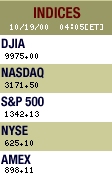
The Dow Jones industrial average closed down 293.5 points, at 10,221.07, while the Nasdaq Composite Index fell 133.27, at 4,415.65.
Adding to the volatility was the fact that the session
marked "double witching," or the simultaneous expiration of
stocks and index option, as well as the last trading period
ahead of a three-day U.S. holiday weekend.
The stock market and bond market, which closed at 1 p.m.,
will both be shuttered Monday in observance of the President's
Day holiday.
"It looks ugly," said Phil Orlando, chief investment
officer at Value Line's Asset Management division. "Everyone is
still focusing on their hangover from Greenspan's testimony. The
economic news was fabulous and you would have thought you would
have a rally if stocks had focused on the economy and the bond
market."
Pulling down the Dow were its interest rate-sensitive
financial names such as American Express Co., off 9-15/16 at
138, and J.P. Morgan, down 3-3/4 at 109-1/8.
as
crude oil prices fell on talk that producers were prepared to
increase production in March, traders said.
Bonds rose and the dollar hit a five-month peak of 111.26
against the Japanese yen.
Oil prices ended near $30 a barrel, but their gains were
limited by uncertainty about whether producers will raise output
levels in March to counteract dwindling oil stockpiles
worldwide. Oil giant and Dow component Exxon Mobil lost 1-5/16 at 76-9/16 on the news.
Palladium prices fell, although the March contract
still closed above $700 an ounce. On Friday, Russia hinted it
might soon resume exports of the precious metal, a key
ingredient in cars' catalytic converters.
A glitch struck the Nasdaq market's operating systems at
about 11:30 a.m. EST, preventing the No. 2 U.S. stock market
from updating the Nasdaq composite index for 2-1/2 hours.
"This is an initial reaction to continued nervousness about
further rate increases and continued reaction to the leadership
in the market — the highly speculative biotech group," said
Larry Rice, chief investment officer at Josephthal Lyon & Ross.
"And there is probably some concern that these benign
numbers can't continue benign. Everyone in the real world sits
back and says we are paying more at the (gasoline) pump so why
aren't these numbers showing up?" he said.
The pull-back was widespread with paper, bank, oil,
utilities and building materials stocks edging lower along with
technology names that rallied a day earlier.
Analysts said Wall Street largely ignored the latest
inflation data January's Consumer Price Index rose just 0.2
percent while economists had expected a 0.3 percent increase.
Excluding the volatile food and energy sectors, the CPI
climbed 0.2 percent — in line with estimates.
"One would have thought that given the data and the strong
bond action, the market should do better," said Donald Selkin,
chief market strategist at Joseph Gunnar & Co. "But the only
place where people make money is in the new economy and the
biotech stocks."
The Dow's slide began on Thursday after Greenspan in his
twice-a-year Humphrey-Hawkins testimony to Congress signalled
more interest rate hikes may be necessary to rein in a
galloping U.S. economy.
Greenspan regains the spotlight on Wednesday with the second
part of his Humphrey-Hawkins testimony, giving Wall Street ample
time to fret about what he might say about interest rates.
Computer giant Microsoft Corp., a Dow component, slipped
4-9/16 to 95-1/16 despite favourable comments from Wall Street
analysts.
— Reuters contributed to this report