Spring is just around the corner, and
some experts are telling stock market investors that it's time
to wake up and smell the flowers.
They say the market is not playing by the rules as it
continues to ignore signs that stocks are over-ripe for a fall.
Stocks have gone through the roof since last summer's
headspinning correction, and analysts are now raising a lot of
questions about the wisdom of this priced-for-perfection market,
particularly the high-flying technology stocks.
"Even on a purely technical basis, the market looks awfully
bearish," said Arnold Kaufman, editor of Standard & Poor's
Outlook investment advisory newsletter.
"The market sentiment is still too bullish, which is a bad
sign," he said. "Also, the leadership and the number of stocks
that rise versus those that fall is poor and the number of
stocks that are making 52-week lows has jumped from 20 to 30 on
the New York Stock Exchange to as much as 200."
The market's ascent has indeed been spectacular.
At its peak in January, the Dow Jones industrial average was
up an impressive 25 percent from its summer low, while the
technology-laced Nasdaq composite index had zoomed 75 percent.
"This huge move in a very short time has made people overly
confident that the market is invincible," said Kaufman.
"Perhaps, this overconfidence could be the one powerful thing
that will undermine the whole market."
The flashing bear signals have prompted one veteran Wall
Street guru to reduce his exposure to stocks.
The reason: The market is losing the fuel that has fed the
bullishness.
"The big factor is the drying up of the money supply, which
had been the backbone of the bull market since the Federal
Reserve cut interest rates last year," said Don Hays, chief
investment strategist for Wheat First Union in Richmond, Va.
The panicky Fed, led by Chairman Alan Greenspan, rushed to
slash interest rates three times late last year. The goal was to
insulate the U.S. economy from the contagion that wrecked the
economies in Asia, Russia and Latin America.
The flooding of the money system did the trick, but it also
created what many suspect was a speculative market bubble. This
happened because the excess supply of cash spilled over to a
stock market that was already priced out of this world.
The Fed is now worried that the bubble could burst and bring
down the economy.
U.S. corporate earnings are shrinking for the second
consecutive year, and fewer companies will find earnings bliss
in 1999 as one-third of the world remains stuck in recession.
The problem is that investors will have a tough time
justifying their hopes of companies' future earnings, with the
forward-looking price/earnings ratio at a record 25.
"This has been an Alan Greenspan inspired four-month bull
market," Hays said. "Now the Fed is starting to drain off some
of that excess money reserve."
Kaufman said that based on the traditional measures, the P/E
ratio would normally be at half the current level.
"You have to be worried about the P/Es," he said.
He said that the market's strength has been built on a
flimsy foundation of booming technology stocks, which have hit
home runs while the rest of the market has struck out.
"The danger is that if the technology stocks lose their
leadership, then the entire market could well go into a
correction," Kaufman said. "This could cause a snowball effect
in the economy as consumer confidence and spending, which have
been propped up by the strong market, fall apart."
Indeed, this week Wall Street may have gotten an early
warning signal that the good times may be about to end for the
techs after Dell Computer Corp. and Hewlett-Packard Co. came out
with good earnings, but their sales growth appeared to be on a
downward slope.
Investors took a jack hammer to Dell's stock, knocking 20
percent from the shares because its sales increased only 38
percent instead of the 50 percent that stockholders had come to
expect for the last two years.
Wall Street also went gunning for Dell because the stock had
led the S&P; index for the past three years with an eye-popping
gain of more than 4,500 percent.
Hays, meanwhile, said he doesn't trust this bull market,
preferring the safety of a blend of cash, Treasury bills and
bonds.
His new allocation recommends that investors put 51.5
percent of their portfolios in stocks, down from 70 percent
previously; 38.5 percent in bonds, up from 30 percent; and 10
percent in cash, up from zero previously.
Hays said other factors have made him turn negative on
stocks, including the overvaluation of the market, which he
placed at nearly 20 percent.
"Stocks have undergone corrections every time they've been
overvalued by 18 percent or more," he said.
Also disturbingly bearish is the ratio of stocks that, on an
average day, have risen and fallen. The so-called market breadth
is near the low point that was reached prior to last summer's
market plunge, which wiped out some 1,800 points from the Dow.
"This is a very unhealthy set of conditions that show that
the four-month bull market was largely the result of a small
group of large-cap stocks moving up," Hays said.
The market sentiment index is also too high, with more than
60 percent of the investment newsletters in the bullish camp.
"This is the highest level of bullish sentiment since
August 1987," said Hays.
Worth recalling is that on Oct. 19, 1987, the stock market
went into a freefall, with the Dow plummeting 508 points to
1,738.74.
Hays said the Dow would need to drop by some 14 percent to
reach what he thinks would be "fair" value, which would put
the blue-chip index at the 7,900 level — but still above last
summer's low of 7,500 after the sharp correction.
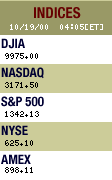
For the week, the Dow Jones industrial average was up 65.06
points at 9,339.95. The Standard & Poor's index rose 9.05 at
1,239.19 while the Nasdaq composite index fell 38.34 to
2,283.60.