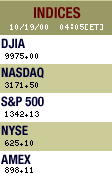
After tumbling below 10,000 for part of Thursday, the Dow closed just above that mark, while the Nasdaq rebounded from a dip in the red to end the day at another record high.
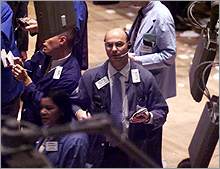
Brad Rickerby/Reuters |
|
| The sentiment on Wall Street was that investors were taking profits from Wednesday's record-shattering run
|
|
The Dow Jones industrial average closed down 133.41 at 10,092.32, adding to Wednesday's 79-point drop, while the Standard & Poor's 500 index was off 7.35 at 1,353.34.
The last time the Dow traded below 10,000 was Oct. 18, and its last close below 10,000 was April 6, 1999, when it stood at
9,963.49. It reached a record 11,722.98 on Jan. 14.
"No one should underestimate the psychology of moving below
10,000," said Hugh Johnson, chief investment officer at First
Albany Corp. "When the Dow dropping moves from the business page
to the front page it will scare some investors ... and could lead
to more selling."
While fears of higher interest rates once again were blamed for the decline of blue-chip stocks, technology investors seemed to brush off such concerns, sending the Nasdaq up 66.5 points, at 4,616.82, a new closing high. That added to the 168.21 points gained on Wednesday.
Technology stocks, which have become largely immune to concerns about rising interest rates, have spent much of 2000 rallying at the expense of old-line blue chip stocks, including retailers and
banks. Investors are increasingly more attracted by the younger
high-tech firms' promise of higher profit gains.
Overall, Internet, computer and telecom stocks had a strong day, while stocks such as Wal-Mart and Johnson & Johnson dragged the Dow lower.
"This is like Groundhog Day. We know this story. We've seen it almost every day," said Arthur Hogan, chief market analyst at Jeffries & Co. He referred to the movie where the main character
keeps living Groundhog Day over and over again.
In the past week, policy-makers from the Federal Reserve have sent clear messages that they intend to raise rates to cool off
inflationary pressures in the robust U.S. economy. Such moves could
hurt corporate profits and slow consumer buying.
Declining issues outnumbered advancers by a 2-to-1 margin on the
New York Stock Exchange, with 1,049 up, 2,014 down and 442
unchanged.
NYSE volume totaled 1.16 billion shares as of 4 p.m., vs. 975.5 million in the previous session.
The Russell 2000 index of smaller companies rose 3.98 to 553.89.
— The Associated Press contributed to this report