The Federal Reserve may be
heading toward a "significant" move to raise interest rates
but it will make the changes in gradual steps, Minneapolis Fed
President Gary Stern said Thursday.
Stern's comments provided further evidence that Fed
policymakers think they may need to raise rates substantially in
the coming months to slow the robust U.S. economy and keep
inflation from taking off.
"It is quite possible that over time, a significant change
in policy might be implemented, albeit on a gradual basis,"
Stern told the Plymouth Rotary Club.
The U.S. central bank has already raised the key federal
funds rate on overnight lending between banks four times since
June, bringing the rate from 4.75 percent at the start of the
credit tightening to 5.75 percent currently.
Wall Street is now bracing for more rate hikes in the coming
months and top Fed officials have not been bashful about warning
that they will continue to act until the rapid-fire pace of
domestic demand slows.
Fed chairman Alan Greenspan said in testimony to U.S.
lawmakers this week that there was little evidence the rate
hikes so far were slowing the economy to a pace the Fed feels
comfortable with.
He made clear that he thought the rate of growth in the
second half of last year — nearly six percent on an annual
basis — could not be sustained without generating inflation.
Both Stern and St. Louis Fed President William Poole, who
spoke at a separate event at Saint Louis University, said they
did not see a threat to the economy from broader inflation as a
result of higher oil prices.
Growing world demand for oil, and not production cutbacks,
was the driving force pushing prices up, Poole said. But despite
oil prices, inflation was benign in January, he added.
Poole said tight monetary policy that keeps inflation under
wraps will keep interest rates lower in the long run, and he
dismissed the notion that higher interest rates depress economic
activity.
Both Stern and Poole are non-voting members of the Fed's
policy-setting Federal Open Market Committee this year.
One of the Fed's preoccupations these days is that a
tremendous run-up in stock prices in the past few years has
created a "wealth effect" where consumers spend more as their
paper wealth grows.
Fed officials fear wealth effect spending is fueling demand
in excess of supply in the U.S. economy and this imbalance could
trigger inflation.
But Poole said it was not clear the U.S. stock market is
overvalued and it was hard to say what implications any
fluctuation in stock prices would have for Fed policy.
"It's not obvious the stock market is overvalued. I don't
know what the right price for the stock market is," Poole said.
"There is so much uncertainty about the stock market that
increases or decreases in the stock market do not in any way
drive me...to believe that there should be any easy or quick
(monetary) policy conclusions that would flow from it."
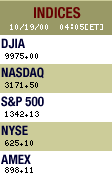
The Dow Jones industrial average, the key U.S. blue-chip
stock index, has seen a bout of weakness so far this year, even
while technology stocks on the Nasdaq composite have been
soaring to eye-popping record highs.
Stern said it was too early to draw any conclusions about
the impact of the Dow's decline on the broader economy. "I
don't think the decline we have had is enough to matter
quantitatively, because you could reach different conclusions."
By the close of trade on Thursday, the Dow was down more
than 12 percent since the start of the year while the Nasdaq was
up about 13.5 percent.