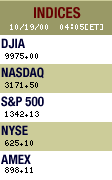
Buoyed by a slight uptick in the unemployment rate, stocks experienced a broad rally Friday, with the Dow Jones Industrial Average closing at 10,367.20, up 202.28 or 1.99 percent.
The tech-heavy Nasdaq Composite also finished in positive territory, continuing its recent rally to close at 4,914.30, up 159.79.
Fueling the rally were two government reports easing investors' fears that the Federal Reserve would take drastic action when that group meets later this month to set interest rates. Friday's Labor Department report, which showed slower job growth and no evidence of wage inflation, calmed investors' fears that the Fed would have to raise interest rates sharply to slow the economy and prevent an outbreak of inflation.
"Finally, an economic indicator the markets could love," said Merrill Lynch's chief economist Bruce Steinberg.
A second report Friday also offered signs of a slowdown. The Commerce Department said orders to U.S. factories fell by a bigger-than-expected 1.1 percent in January, the steepest drop since April. The decline was led by a huge 12.9 percent drop in orders for electronics, the sharpest decline since July 1997.
Even though economists widely expect the Fed will boost rates
March 21, they said the unemployment report all but assures a
moderate move of a quarter of a percentage point, rather than the
half-point increase some feared.
The central bank has raised interest rates four times since June
to slow the economy and to keep inflation under control.
The unexpected uptick in last month's jobless rate followed
January's 4 percent rate, the lowest in 30 years. Many analysts had
predicted February's rate would hold steady.
Another surprise to many economists was the slowdown in job
growth, which has been particularly hardy in recent months. Only
43,000 workers found employment in February, a nine-month low. Most
analysts were forecasting that 228,000 workers would find jobs.
Sluggish growth in the service sector, normally an engine of job
creation in the United States, helped retrain overall job growth.
The sector added just 62,000 jobs in February, the fewest since
August 1997.
Construction companies lost 26,000 jobs after posting a colossal
116,000 gain the month before aided by mild weather.
"The U.S. job machine hiccuped in February, generating a
fraction of the new employment that had been expected," said Bill
Cheney, chief economist at John Hancock Financial Services.
But while investors viewed this as the start of a slowdown in
the economy, economists were more cautious.
"It's too early to call a turn in the trend, so Alan Greenspan
can't relax completely, but it's certainly the kind of report that
will help him sleep better," Cheney said. "Another couple like
this for March and April and he might even put off any more
interest rate hikes for a while."
Economists pointed out that job growth over the last three
months averaged a robust 245,000, a level that would be too strong
for the Fed's liking.
"You would need a couple of months of slower job growth to
make the case of a slowdown in the economy," said Sandra Shaber,
economist with the WEFA Group.
For similar reasons, Labor Secretary Alexis Herman said she
isn't concerned about the lower-than-expected 43,000 jobs created
last month. "I think workers still feel secure about this job
market," she said.
A whopping 384,000 jobs were added to businesses' payrolls in
January thanks to better-than-normal weather in the early part of
the month.
Average hourly earnings, a key gauge of inflation pressures,
rose by 0.3 percent to $13.53 in February — on target with most
analysts' expectations. In January, wages grew by a 0.4 percent.
"There's no indication that wage growth is exploding, which is
something the Federal Reserve would be on the lookout for," said
KeyCorp economist Ken Mayland.
Economists always keep tabs on wage and job growth. While wage
and job gains are good developments for workers, economists and
members of the Fed worry that too-strong growth could spark
inflation. Their fear: Employers trying to attract qualified
workers will offer higher wages and benefits, forcing them to boost
the price of their products and thus setting off higher inflation.
In February, 33,000 workers found jobs in the retail industry
with the largest gains in department and furniture stores.
Manufacturers, which lost 248,000 jobs last year, added 5,000 jobs
reflecting big gains in electrical equipment, automobile production
and industrial machinery.
— The Associated Press contributed to this report.