Federal Reserve Chairman Alan Greenspan sent financial markets on alert Monday, after hinting that the U.S. central bank will have to raise interest rates even further to avert inflation.
In his speech at a Boston College conference on the "New Economy," Greenspan voiced concerns that the economy is growing too rapidly given the dwindling supply of new workers and the increasing need to rely on imported goods.
His comments are likely to strengthen the belief of many economists that the Federal Reserve will continue to raise interest rates until it sees greater evidence that the economy is slowing enough to keep inflation under control.
Overall, Wall Street had a negative reaction to Greenspan's remarks.
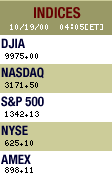
The blue chips took the biggest hit with the Dow Jones industrial average falling 196 points to end at 10,170. Declining issues beat gainers 19 to eleven, with more than one billion shares traded on the New York Stock Exchange.
 |
 |
 |
| |
'The expansion of demand must moderate,' — Alan Greenspan
|
|
 |
 |
 |
|
Broader market averages also lost ground. The S&P; 500 index
dropped 17 points to end at 1,391. The Nasdaq composite
managed to buck the downward trend for much of the session, but in
the end it fell 10 points to end at 4,904.
Amex was up 8.65 to 1022.36.
In his speech, Greenspan reiterated the danger signs lurking in the economy.
"Overall demand for goods and services cannot chronically
exceed the underlying growth rate of supply," Greenspan said.
"The expansion of demand must moderate."
The Fed works to achieve this moderation by increasing borrowing
costs for consumers and businesses, cutting into demand for
big-ticket items such as homes and autos. The central bank has
already boosted interest rates four times since June with the
latest increase on Feb. 2, a quarter-point boost that left the
federal funds rate at 5.75 percent.
Economists are predicting the Fed will raise rates again when it
next meets March 21; many are also looking for a sixth rate increase
at the following meeting, on May 16.
Greenspan said the Fed's efforts to slow the economy by raising
the short-term interest rates that it controls are being aided by
increases in long-term interest rates, which are controlled by
financial markets.
He said long-term corporate borrowing costs "have risen
significantly over the past two years" because of continued strong
demand for new loans on the part of consumers and businesses.
Greenspan noted that the higher business borrowing costs were
prompting many analysts to project that stock market gains may
begin to slow as increased interest payments by businesses cut into
corporate profits.
Greenspan said the central bank will be carefully monitoring
developments to bring about the required movements in the economy
to better balance the supply of labor and capital with demand.
"Until market forces, assisted by a vigilant Federal Reserve,
effect the necessary alignment of the growth of aggregate demand
with the growth of potential aggregate supply, the full benefits of
innovative productivity are at risk of being undermined by
financial and economic instability," he said.
Even with those threats, Greenspan said Americans are living
through remarkable economic times with a strong surge in workers'
productivity helping to boost incomes and keep inflation from being
a problem. The current expansion became the longest in U.S. history
at 107 months in February and this month is celebrating its ninth
birthday.
"Not only has the expansion achieved record length, but it has
done so with economic growth far stronger than expected,"
Greenspan said. "Most remarkably, inflation has remained largely
subdued in the face of labor markets tighter than any we have
experienced in a generation."
On Friday, the government reported that the unemployment rate
edged up to 4.1 percent in February from 4 percent, which had been
the lowest jobless rate in 30 years. Some analysts saw the slight
uptick in the jobless rate as the first indication that the Fed's
efforts to slow the economy were beginning to have an impact.
— The Associated Press and Reuters contributed to this report