Securities and Exchange
Commission Chairman Arthur Levitt said on Monday that he was
concerned many retail investors did not fully understand how the
financial markets work and were overextending themselves.
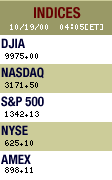
With the New York Stock Exchange and the Nasdaq rising to
unprecedented heights and retail investors becoming the driving
market force, he said there is a risk these investors could fall
victim to unwarranted optimism because they do not understand
the fundamentals of market dynamics.
"But in the celebration of today's prosperity, I'm
concerned that some of the basic but important fundamentals of
investing are being lost on investors. Or, even worse, being
ignored, " Levitt said in a speech at Boston College's Finance
Conference 2000.
"Unless investors truly understand both the opportunities
and the risks of today's market, too many may fall victim to
their own wishful thinking," Levitt said.
While some of the euphoria is justified, Levitt warned that,
as in the early days of the car business and the personal
computer industry, many of today's Internet companies would fail
in the long run. He said this should raise questions about the
valuation of many of these firms and about their ability to
survive.
"Valuing a company has never been an exact science. But in
today's market, does it even make sense anymore to look at a P/E
ratio? Are some of today's companies really worth one thousand
times nothing?" he said.
"Any way you look at it, many of today's valuations seem to
defy traditional explanation. The run-up of these valuations is
largely the result of multiple stock splits and soaring stock
prices fuelled by an almost insatiable investor appetite,"
Levitt said.
He said all this investor activity creates pressure on new
companies to provide huge returns. Many of the start-ups go
public too quickly.
"Sometimes their race to an IPO comes at the expense of
laying a foundation for a viable, long-term company," he said.
While Levitt said there was nothing wrong with buying on
margin, he said many investors did not understand it.
"I am very concerned about investors who may be borrowing
on other assets such as homes or real estate to invest in our
markets," Levitt said, noting that there is nothing wrong with
controlled, informed margin buying.