U.S. blue-chip stocks and
bonds fell sharply on Monday as Federal Reserve Chairman Alan
Greenspan again signaled the need for higher interest rates to
ward off inflation in the booming U.S. economy.
The dollar held steady as dealers ignored Greenspan's latest remarks.
Crude oil prices soared, closing at the highest level since
the Gulf War as a debate raged within the Organization of
Petroleum Exporting Countries on whether or not to ease up on
oil export curbs. Gold and silver prices fell on light volume.
The Nasdaq market, whose technology stocks are generally
seen as more immune to interest rate hikes than cyclical and
banking issues, slipped into the red late in the session after
its big names like Microsoft Corp. weakened.
"I think the expectation that the Fed is going to hike
rates is causing the blue chips to sell off," said Dan Ascani,
of Global Market Strategists Inc. "I think that people have
pretty much acknowledged that if the interest rate environment
is going to remain hostile, then basic industry and financial
stocks have had it, and the technology stocks may be somewhat cushioned."
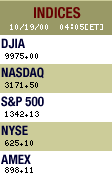
The Dow Jones industrial average fell 196.70 points,
or 1.90 percent, to 10,170.50, giving back some of its gains
from last week's surge of more than 5 percent.
Predictably, some of the Dow's losses came from interest
rate-sensitive financial services firms like American Express
Co., which lost 4-1/16 to 129-7/16.
But also hurting the stock index were technology components
such as computer maker International Business Machines Corp.,
off 5-15/16 at 103-1/16, and software maker Microsoft, down 5-1/2
at 90-5/8.
Bill Gates, founder of Nasdaq-listed Microsoft, filed to
sell about $28.65 million worth of common stock in the company,
according to documents filed with the Securities and Exchange
Commission and made available on Friday.
The sale represents a small fraction of Gates' holdings in
Microsoft. As of September 1999, the latest available data
showed he owned more than 780 million shares, or 15.3 percent,
of Microsoft, a stake worth more than $73 billion at the current price.
Bucking the downtrend in the 30-stock Dow was computer maker
Hewlett Packard Co., which jumped 7-2/16 to 145-9/16 after its
spin-off, Agilent Technologies Inc., announced a new fiber-optic
technology. Agilent surged 42-9/16 to 151-1/16.
The broader Standard & Poor's 500 Index surrendered
17.89 points, or 1.27 percent, to 1,391.28, as fears about
higher interest rates gnawed at cyclical and retail stocks.
Rising oil prices eroded transportation stocks.
The Nasdaq Composite Index dipped 9.92 points, or 0.2
percent, at 4,904.87, after setting a record close of 4,914.79
last Friday.
Analysts said technology stocks avoided more serious damage
because tech companies often raise funds through venture capital
and stock offerings, making them less subject to a slowdown in
the current rising interest-rate environment.
In a speech in Boston, Greenspan repeated his message of
last month that productivity-driven stock gains had boosted
demand in the economy to a level where it could no longer be met by supply.
"It is still a tale of two markets," said Peter Coolidge,
senior equity trader at Brean Murray & Co. "The higher interest
rate environment seems to hurt stocks of the Old Economy while
there is an argument to be made that technology and
biotechnology shares are somewhat immune to interest rate
increases. The problem is that this is getting somewhat
overdone."
Adding to the market jitters, Securities and Exchange
Commission Chairman Arthur Levitt said on Monday that he was
concerned many retail investors did not fully understand how the
financial markets work and were overextending themselves.
The benchmark 30-year Treasury bond was down 7/32, or
$2.1875 on each $1,000 of face value. The yield, which moves in
the opposite direction, rose to 6.15 percent from 6.13 percent
at Friday's close.
In currency markets, the euro settled at $0.9588, down
slightly from $0.9597 late on Friday. The dollar edged down to
107.40 Japanese yen from 107.72 yen.
At the New York Mercantile Exchange, crude oil for April
delivery closed 67 cents higher at $32.18 a barrel, surpassing
the closing price of $32.00 on January 16, 1991. It was also the
highest price since November 29, 1990, when it settled at $32.91
after Iraq's invasion of Kuwait in August of that year.
Spot bullion was last quoted at $287.40, down from Friday's
New York close of $289.20. Spot silver was quoted at $5.06, down
from $5.04 at the previous close.