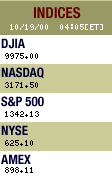
Shares around the world may get a psychological lift if the Dow Jones industrial average pierces
the 10,000 point level, but the thin air above five figures
holds more dangers than charms, analysts said on Monday.
Western equity markets would be likely to join the party if
the most closely watched indicator of U.S. financial strength were to get a foothold above 10,000.
But for many, rational justifications for further gains in
global equity prices are not easy to find after the relentless
rise in recent weeks and months.
"The magic of 10,000 is more mystical than financial,"
said Michael Hughes, director of Baring Asset Management. "If
we get there on the basis of U.S. bond yields falling, then
there can be a significance for the rest of the world. If it
gets there for the sake of getting there, on momentum and by
decoupling with bonds, then it is not good news."
Technical analysts said a Dow break above 10,000 would be
likely to boost equities elsewhere, but were cautious about the
medium term outlook.
"If the uptrend is there and the Dow goes above 10,000, it
will mean the U.S. is on track for further growth," said
Richard Marshall, a director at Investment Research of Cambridge
Ltd.
"This would give world equities more confidence — but
whether this is justified is another matter."
The Dow ended 1998 at 9,181 supported by low 30-year
Treasury yields of 5.10 percent and has risen almost eight
percent so far in 1999 despite yields climbing to 5.53 percent.
Rising interest rates undermine equity valuations by making
other competing investments more attractive and by raising the
costs of corporate borrowing.
"If someone said at the end of 1998 that long term interest
rates would be back above 5.50 percent by March but the Dow
would be hitting 10,000, you would have said they were mad,"
said Bill O'Neill, global strategist at HSBC in London.
"It's money, money, money. It is just money going into the
market," O'Neill said.
The risk is the Dow breaches 10,000 on a wave of enthusiasm
only to be marked down heavily if earnings disappoint or
inflation threatens, analysts said.
This would almost certainly pull the rug from under Europe's
bourses, especially if they had surged on the Dow's gains.
"There is a growing feeling that this is the last gasp
attempt at the topside and that we will see heavy sellers come
in once it goes," said Peter Thomson, senior currency analyst
at Thomson Global Markets in London.
"The longer the market looks at it, the higher the risk of
a disappointment factor."
Although the Dow grips the imagination of investors, it
contains no pure technology shares and its days as an accurate
barometer of the U.S. economy are gone, analysts said.
Much of the latest leg of the Dow's rise has come on the
back of strong performance by Chevron (CHV.N) and Exxon Corp.
(XON.N), which have outperformed as the price of oil has risen
in the past week.
But there are few doubts that investors in developed markets
would celebrate the Dow's big rite of passage, if it comes.
"Whether you like it or not Wall Street is still the
lynchpin for the Western markets," said Edwina Neal, global
strategist at Lehman Brothers in London.