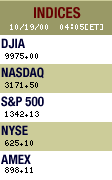
Even as it brushes up against a remarkable milestone at 10,000, the Dow Jones
industrial average is fighting to retain its relevance in the
information age.
Back when it made its first close over 1,000 in 1972, it was
an important fixture of the nightly news — but like the network
TVs newscasts whose ratings have slipped due to cable and other
new media, so too has the Dow's prestige. Both, it appears, are
victims of new technology.
"The Dow 30 is now a much smaller percentage of market
capitalization than it once was — primarly due to its exclusion
of technology stocks," said Joe Abbott, market analyst for
research firm I/B/E/S International.
The index has long been a been the showcase for blue chip
giants: International Business Machines Corp. (IBM.N), General
Motors Corp. (GM.N), General Electric Co. (GE.N) and AT&T; Corp.
(T.N) are synonymous with America's industrial might.
But those giants have been surpassed, at least in investors'
minds, by fast growing U.S. high-tech companies not even listed
on the Dow. Microsoft Corp. (MSFT.O), Intel Corp. (INTC.O), Dell
Computer Corp. (DELL.O), Cisco Systems Inc. (CSCO.O) all trade
on the Nasdaq market and none was even listed when the Dow first
touched 1000.
Add the value of those four Nasdaq leaders and you have a
market value of $865 billion — while the aforementioned leading
Dow stocks are valued at $725 billion. Overall, the Dow stocks
represent just $2 trillion, of the $18 trillion in total market
capitalization, said Alan Ackerman of Fahnestock & Co.
The Nasdaq companies, while still smaller than the Dow
counterparts in terms of sales, are producing bigger earnings
growth, and that's why Wall Street is rewarding them with a big
market value.
While there is no rule that Nasdaq stocks can't be listed on
the Dow, so far it's never happened, with the index comprised of
big, stable NYSE-listed stalwarts. Dow Jones says it wants its
list to reflect broadly traded industrial leaders — and it
doesn't want it to be a "hot stocks" index.
But hot stocks are increasingly driving the market, with more
small investors players than ever in the market. Some 7 million
investors have gone online the past two years alone, and they
are more likely to buy Dell and Yahoo! Inc. (YHOO.O), than Dow
component Alcoa (AA.N). Mutual fund managers, too, have found
more takers for emerging growth and high technology funds that
cater to growth- and high-tech-hungry investors than "stable
growth."
"The Nasdaq is heavily tilted toward technology stocks and
clearly those have been the energizers of the big market
moves," said Ackerman.
But it's not just small investors chasing tech stocks who
downplay the significance of the Dow. Analysts and economists,
too, look elsewhere when they're tracking the market.
"It's not an analytical factor — all our modeling work and
statistics are based on the S&P; 500 index," said A.C. Moore of
Santa Barbara, Calif.-based Dunvegan Associates.
Charlie Crane, strategist for Key Asset Management, agrees,
"The Dow is not nearly as important as the S&P; 500," though
both Crane and Moore say they look regularly at the blue chip
average as a "psychological indicator." It also provides a
good "shorthand" for telling people what the market is doing.
The S&P;, though, is broader and more inclusive, with
companies like Microsoft and Intel part of the list. The
Department of Commerce and the Conference Board both use it for
an economic indicator.
Still, some see the index of blue chips regaining stature if
the era of the growth stocks — fostered by low inflation and
interest rates — gives way to the more erratic patterns of the
past.
Fear that the long boom might be ending, ironically, might be
helping the Dow right now, said Harry Laubscher of Tucker
Anthony, who notes that buying is concentrated in the blue chips
and just a few hot tech stocks, but that broader indicators are
deteriorating.
"The overall market's really been strong since the
mid-1980s," he said. "But when the market starts tumbling, the
better quality, blue chips stock like the ones in the Dow do
better."
When the S&P; index went online in 1957, the Dow was already
enshrined as the indicator of America's booms and busts and it
remains the icon for Wall Street's daily movements going into
the new millennium.
Marshall Acuff, of Salomon Smith Barney said, "You can argue
that the Dow is not that representative, but you'll probably
never read a headline that says S & P index up 2.2 points at
1,296."