Billionaire investor
George Soros said on Monday time was running out to shore up
Brazil's economy and urged the International Monetary Fund (IMF)
to take quick action.
Michel Euler/AP |
|
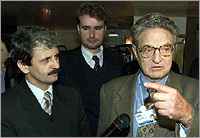
| George Soros, chairman of the Soros Foundation, right, with Mikulas Dzurinda, Prime Minister of Slovakia
|
|
Soros, a vocal critic of the IMF's track record in dealing
with crises, said the IMF should release more funds to Brazil
under its $41.5 billion credit package to help the country fight
its worst economic crisis in years.
"This is the moment. I don't think there is a great deal of
time, really," he told a news conference at the World Economic
Forum's annual meeting, adding that Brazil's situation would
become harder to stabilize as time passes.
"Brazil is a very acute situation because on Friday you
effectively had the beginning of a run on the banks and a run on
the currency," he said, referring to the real currency's slide
past the psychological two-per-dollar level last week.
"Right at this minute, Brazil has arrived at the point
where interposing a wall of money would stabilize the
situation."
Soros' comments come at a crucial time for Brazil as the
government meets with an IMF team in the country to press for
the disbursement of a second instalment of credit, having spent
the first batch in a futile attempt to prop up the real.
Brazil's real has fallen about 40 percent in the past two
weeks since the government was forced to stop defending it.
"The currency was overvalued, but the currency, if
anything, is now undervalued," Soros said.
The real firmed in early trade in Sao Paulo on Monday to
about 1.99 to the dollar versus Friday's finish of 2.1.
Despite its precarious economic situation, Soros said
Brazil's situation was less critical than the Russian crisis,
due partly to the South American giant's fiscal reforms.
"The case of Brazil is very different from Russia. To put
money on the line in Russia would have been a high-risk
proposition, whereas putting money on the line now (in Brazil)
would be a low-risk situation," he added.
Soros said the impact of Brazil's crisis on global financial
markets was relatively limited now.
"The wrecking ball has stopped swinging. (Brazil) has
repercussions, but it's losing force," he said.
Soros lambasted the Brazilian government's attempts to fight
the crisis by jacking up interest rates.
"I think it was a disastrous move," he said, adding that
higher rates made it harder for Brazil to pay its domestic debt
and thus raised market concerns about the country's solvency.
Regarding proposals that Brazil should adopt an
Argentine-style currency board, Soros said, "A currency board
is possible in the longer run. Conditions are not quite there
right now. But I think it is under active consideration."
He called for a mixture of governmental and private
investment and lending in the world's eighth-largest economy.
Soros said he didn't think it would take much more money to
stabilize the Brazilian situation beyond the $41.5 billion
credit package agreed with the IMF in November.
He added that Brazil only needed a "further enhancement"
of funds from Group of Seven countries and the private sector.
Regarding Russia, Soros reiterated that his investment fund
had been hit by the crisis there, but said he remains heavily
committed to the country's recovery.
"It has been rather unrewarding. We've suffered major
losses, and I've stated that," he said, adding that the country
could begin to turn around once its current political
uncertainties are cleared up.