Brazilian President Fernando
Henrique Cardoso, with his popularity at its lowest ever, was
under pressure Monday to show resolve with the currency crisis
after nervousness spilled from the global marketplace out onto
the street.
Douglas Engle/AP |
|
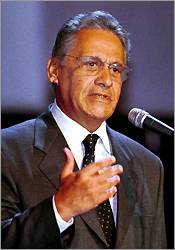
| President Cardoso speaks at the inauguration of a television studio in Sao Paulo
|
|
Nearly three weeks after markets forced him to abandon the
strong currency policy that beat inflation, Cardoso has seen his
real's value slide by 40 percent, dragging his credibility down
with it.
In a crucial week at home, Cardoso's cabinet will have to
convince the population that it will not take drastic measures
to deal with the crisis, like freezing bank accounts — rumors
that caused isolated above normal withdrawals at a few bank
branches.
For the second time in 12 hours, Finance Minister Pedro
Malan assured television viewers early Monday that there would
be no bank holiday to announce surprise measures and no
confiscation of Brazilians' money. He called Friday's rumors
"criminal."
Cardoso's economic team will also hunker down with a beefed
up International Monetary Fund mission to Brasilia, led by First
Deputy Managing Director Stanley Fischer, to speed up a fresh
transfer of money to the world's eighth largest economy.
Fischer said Sunday that the real had fallen too much
against the dollar, but will strengthen if the country adopts a
credible monetary policy.
"As soon as that happens, or a little after because it
takes time for credibility to be gained, the exchange rate
overshooting will begin to reverse, (and) the currency will
strengthen," Fischer said in a panel discussion at the World
Economic Forum annual meeting in Davos, Switzerland. He arrives
in Brazil Monday.
Brazilian media reported that the IMF team will demand that
Brazil's government raise annual interest rates to 70 percent
from 37 percent now as part of the credible monetary policy.
Brazil has already raised rates three times in two weeks.
After opening meetings with the IMF team Sunday, Brazilian
officials gave no clues to possible changes in policy, but noted
that Fischer's participation will add strength to the
discussions.
Brazil needs to renegotiate the economic targets set with
the Fund last November in exchange for a $41.5 billion
international credit line, meant to save Brazil from a
Russia-style economic collapse.
Once the two sides have agreed to new parameters on interest
rates, a budget deficit and exchange policy, Brazil can receive
a second $9 billion disbursement of the loan package after
having spent the first chunk in a futile attempt to defend the
real.
Fischer noted that Brazil has made progress in the last two
weeks in its drive to slash the budget deficit, considered to be
the root of the country's financial problems at a crippling 8
percent of gross domestic product (GDP).
As the government appears to be on its way to convincing the
IMF of its credibility, Brazilians seem less than impressed with
the performance of Cardoso.
According to an opinion poll published by the Datafolha
agency Sunday, 70 percent of those polled in the business
capital, Sao Paulo, said Cardoso had lost control of the crisis,
and 59 percent believed he had deceived Brazil's electorate with
his promise to maintain currency stability.
Cardoso's approval rating when he was reelected in October
was more than 50 percent. The Datafolha poll showed that 38
percent considered his personal performance in the crisis as bad
or very bad, with 22 percent regarding it as good or excellent.
It was Cardoso's lowest popularity rating since he became
president in January 1995.